Indian Peafowl
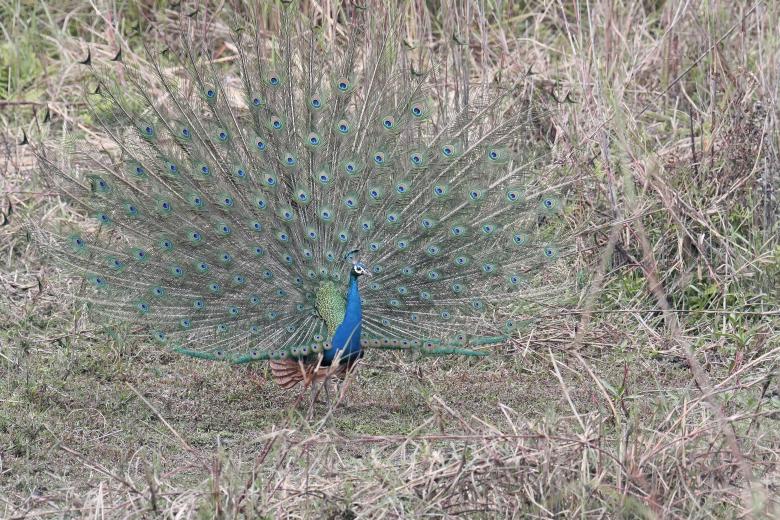
Simply known as a peacock, this bird is large brilliantly plumaged, robust pheasant. It has a small velvet blue head. Velvet blue neck that turns green towards the belly, barred upper parts and bright chestnut primaries. Its dark eye stripe separates the white supercillum from its cheeks. The upper tail coverts extends into spectacularly marked train that opens in a display. The male is seen sporting its long eyed train which is displayed quite dramatically during monsoon. The train grows in size as the male matures. The female has a brown plumage and lacks the train, even though its upper tail is slightly extended. The juvenile is similar to the female, but is mostly brown with a spiky crest, it roots in tall trees, in dry forests orchards, cultivated areas and human settlements. It is very noisy during monsoons. A male may mate with several females, then leave to nest alone digging a shallow scrape on the ground into which about six eggs are laid, these are incubated for about four weeks. Following hatching the chicks will remain with their mother for ten weeks. First year the male lacks the train and is similar to the female but head and neck are blue and primaries are chestnut with dark brown mottling. Second year male more closely resembles adult male but has a short train, which lacks ocelli and is barred with green and brown, length of the train increases in the fifth or sixth year. The sounds like a trumpeting for carrying and mournful kee-ow, kee-ow, also series of short blasting screams like ka-an ka-an repeated six to eight times. It is always seen in small flocks usually one cock and three to five hens when breeding.
 Similar Sponsored Images




 Similar Sponsored Footage
Popular Photos From sylvester alphonso